---
title: What is the learning environment?
description: What is the learning environment when creating a role, variety, pace, speed, learning. Aptitude, assess
---
[Skip to content](https://knowledge.thomas.co/assess-connect/what-is-the-learning-environment#main-content)
- [English](https://knowledge.thomas.co/assess-connect/what-is-the-learning-environment)
- [Français](https://knowledge.thomas.co/fr/assess-connect/lenvironnement-dapprentissage-)
- [Nederlands](https://knowledge.thomas.co/nl/assess-connect/de-leeromgeving)
English
Show submenu for translations
[Raise a Ticket](https://knowledge.thomas.co/assess-connect/kb-tickets/new?hsLang=en)
[](https://knowledge.thomas.co/?hsLang=en)
- [Training](https://www.thomas.co/uk/solutions/training-accreditation)
- [Professional Services](https://www.thomas.co/uk/professional-services)
- [Integrations](https://www.thomas.co/uk/platform/integrations)
- [Digital Badging](https://www.thomas.co/digital-badging)
Open main navigation
Close main navigation
- [Training](https://www.thomas.co/uk/solutions/training-accreditation)
- [Professional Services](https://www.thomas.co/uk/professional-services)
- [Integrations](https://www.thomas.co/uk/platform/integrations)
- [Digital Badging](https://www.thomas.co/digital-badging)
- - [English](https://knowledge.thomas.co/assess-connect/what-is-the-learning-environment)
- [Français](https://knowledge.thomas.co/fr/assess-connect/lenvironnement-dapprentissage-)
- [Nederlands](https://knowledge.thomas.co/nl/assess-connect/de-leeromgeving)
English
Show submenu for translations
- [Raise a Ticket](https://knowledge.thomas.co/assess-connect/kb-tickets/new)
- [Go to thomas.co](https://www.thomas.co/)
[Go to thomas.co](https://www.thomas.co/)
Search the Knowledge base
- There are no suggestions because the search field is empty.
1. [Assess & Connect](https://knowledge.thomas.co/assess-connect?hsLang=en)
2. [Expert Insight](https://knowledge.thomas.co/assess-connect/expert-insight?hsLang=en)
# What is the learning environment?
## The learning environment within the Assess section of our platform plays a key role in defining what a job truly demands, beyond just qualifications or experience. It provides a framework for understanding the kind of thinking, adaptability, and learning pace that contribute to success in a role.
When setting up a role in the Assess tab, the learning environment helps define the cognitive and experiential demands of the position. It looks at four key dimensions:
1. #### **Level of experience required**
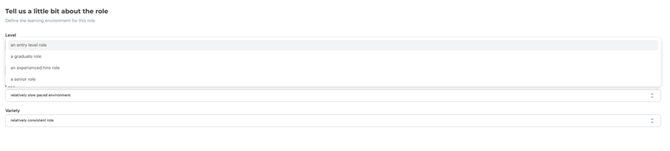
\- **Entry-level role**: No prior experience necessary.
\- **Graduate role**: Some professional qualification or learning required.
\- **Experienced role**: Prior experience in the working world with a need for industry knowledge.
\- **Senior role**: Higher complexity level within the role, possibly managing others.
2. #### **Learning demands of the role**
#### 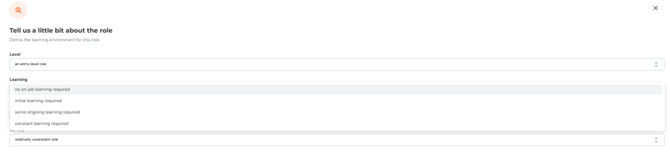
- **No on-the-job learning required:** Easy to step into the role with limited need for new skills.
- **Initial learning required:** There is a need to have some initial onboarding and upskilling but no further training will have to take place.
- **Some ongoing learning required:** They will occasionally need to update their skills through training based on changes in the role or industry.
- **Constant learning required:** Constant need for upskilling and training as new challenges and approaches occur regularly.
3. #### **Pace of work**
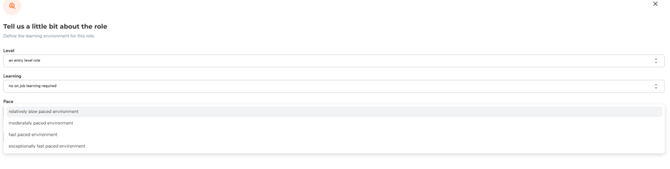
- **Relatively slow paced environment:** Very routine work where there is a low demand on delivering daily results.
- **Moderately paced environment:** Deadlines may be occasionally shorter, but generally the pace of work will be stable.
- **Fast paced environment:** Deadlines need to be delivered on quickly and regularly.
- **Exceptionally fast paced environment:** Deadlines need to be delivered on extremely quickly within short notice at a very fast pace.
4. #### **Variety of tasks and responsibilities**
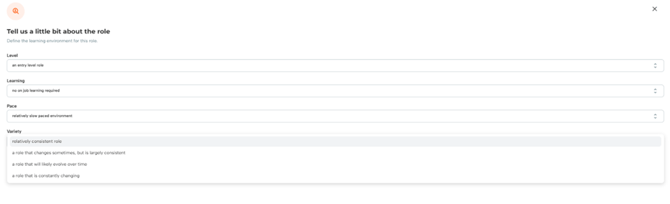
- **Relatively consistent role:** Routine work with little changes to outcomes.
- **A role that changes sometimes, but is largely consistent:** There will generally be routine work to complete, with occasional different processes or tasks to take on.
- **A role likely to evolve over time:** The types of tasks may change in response to business needs.
- **A role that is constantly changing:** A need for consistent development due to regularly changing business needs, organisational strategy or tasks.
These inputs help shape a picture of the kind of work environment someone will be stepping into.
*It is important to note that the questions help define the learning environment associated with the role. Each set of options represents different requirements and is not necessarily ranked on a scale from less important to more important for the role.*
Once selections are made across all four categories, as seen above, the system calculates an ideal **benchmark percentile.** This helps determine the level of **Aptitude** that is likely to lead to success in the role.
The system then compares a candidate’s Aptitude score against this benchmark to generate a star rating.
Ratings reflect how closely a candidate’s Aptitude aligns with the role’s defined learning environment:
 - Indicates very strong alignment
- Indicates moderate alignment
- Indicates limited alignment
This scoring is always comparative and role-specific; it is not about "good or bad" Aptitude but about **fit** for the environment described.
The logic behind the learning environment is grounded in science, allowing role definitions to go beyond surface-level traits. As informed by research, it must be noted that aptitude scores that are higher than what is required for the role are not penalised in the star rating. This helps ensure that candidate-job matches are both evidence-based and adaptable to a wide range of industries and seniority levels.
- [Employee Experience](https://knowledge.thomas.co/assess-connect/employee-experience?hsLang=en)
- [Expert Insight](https://knowledge.thomas.co/assess-connect/expert-insight?hsLang=en)
- [HR Experience](https://knowledge.thomas.co/assess-connect/hr-experience?hsLang=en)
- [Manager Experience](https://knowledge.thomas.co/assess-connect/manager-experience?hsLang=en)
- [Settings](https://knowledge.thomas.co/assess-connect/settings?hsLang=en)
- [Thom AI](https://knowledge.thomas.co/assess-connect/thom-ai?hsLang=en)
- [Training](https://www.thomas.co/uk/solutions/training-accreditation)
- [Professional Services](https://www.thomas.co/uk/professional-services)
- [Integrations](https://www.thomas.co/uk/platform/integrations)
- [Digital Badging](https://www.thomas.co/digital-badging)
[](https://thomas.co)
[mailto:email@email.com](mailto:email@email.com)
Copyright © 2025, Thomas